
Navigating Digital Welfare
Introduction
Navigating Digital Welfares is a research project using arts-based methods to understand and highlight the complex experiences of parents navigating social security in an increasingly digital world.
Public organisations are turning to digital, online, and automation approaches to deliver social security benefits, claiming simplicity for service users and administrators. However, post-2014, multiple organisations in Scotland are now responsible for an increasing range of social security benefits, each with their own application process, digital interface, and administrative approach.
The Navigating Digital Welfare project uses arts-based methods and dialogue tools to focus on parents’ experiences of applying for multiple benefits. By adopting the viewpoint of user, the project seeks to understand the complexities across the welfare system in order to improve public services to make it easier for people to access their entitlements.
For more information, view the project website.

Project aims
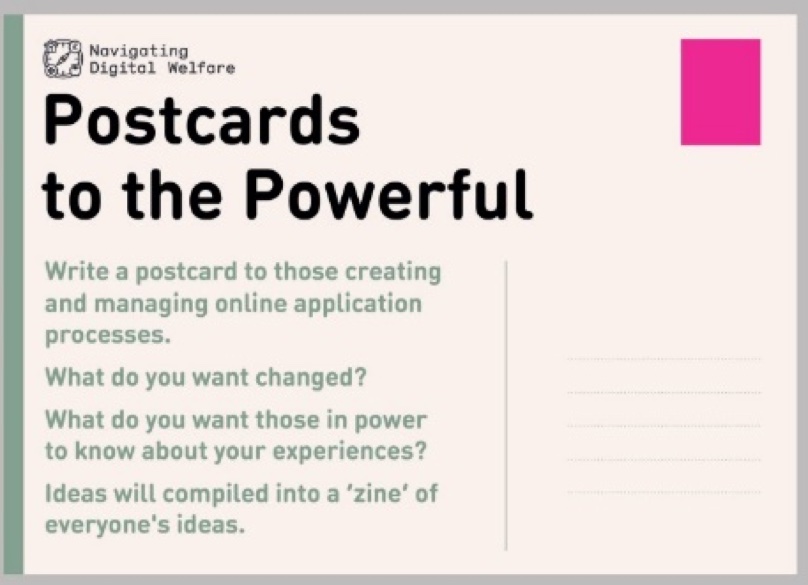 Piloting arts-based methods – such as photo interviews, mapping, graffiti wall, and ‘postcards to the powerful’ – to capture how individuals experience and navigate multiple interfaces.
- Unearth and report on the experiences in order to improve access to benefits and reduce burden placed on individuals.
- Produce an engagement report about the suitability and success/limitations of creative methods for engaging with parents.
- Produce an online zine outlining the experiences we heard about the system and how it could change.
Project dates: Jan 2022-Aug 2022
Intended Outcomes
- Greater awareness of the experiences of people navigating numerous online platforms.
- Highlight the reality of multi-level welfare systems using different application processes.
- Generate knowledge and insights for researchers and others seeking to improve how we engage with people experiencing poverty and the use of digital interfaces as administrative tools.
- Seek to influence Scottish Government and DWP design processes and interactions between systems.
The people involved
Dr. Hayley Bennett is a Lecturer in Social Policy at the University of Edinburgh (PI). Research interests include UK welfare reform, social security, and public administration approaches. Formally research fellow on What Works Scotland, Combating Poverty in Europe project. Worked as a specialist advisor Scottish Affairs Committee exploring multi-level benefits and welfare devolution. Expert advisor for Scottish Parliament in new Social Security powers. Co-convener of Social Policy Association’s ‘Employment and Social Security Policy Group.’
Dr Morgan Currie is a Lecturer in Data & Society at the University of Edinburgh (Co-I). Research and teaching interests focus on open and administrative data, automation in social services, activists’ data practices, civil society and democracy, social justice and the city, cultural mapping, and libraries of things. Currently PI on ‘Automation of Universal Credit’, an ESRC-funded project on the emergence of automated social services and their effects on claimants.
Charlotte Zealley is a Research Assistant and Doctoral researcher in Social Policy at the University of Edinburgh.
Partners include:
- Scottish Government (Reserved Benefits Team)
- Child Poverty Action Group (CPAG Scotland)
- Poverty and Inequality Commission
- Poverty Alliance
- Department for Work and Pensions
- One Parent Families Scotland
Funded by University of Edinburgh/EFI Challenge Investment Fund.

Want to get involved in research with the Binks Hub?
If you've got an idea for a research project – or are already working on a research project – which you'd like to talk to the Binks Hub about, please just send us an email. We'd love to hear from you.